REMAKE (ROSS MCELWEE, 2026)
Remake follows an attempt to adapt McElwee’s first feature, Sherman’s March, into a new work of fiction, in the same way Sherman’s March follows Sherman’s March, in that, it doesn’t, really. McElwee uses his films to explore what he experiences personally, rather than what the subject matter may appear on the surface. In Sherman’s March, McElwee spends his time meeting women, and failing to form relationships with them, all under the guise of making a film retracing General Sherman’s route through the South, and here, in Remake, Ross McElwee uses the option of a remake to reflect on his life, and more so, his son, Adrian’s, death.
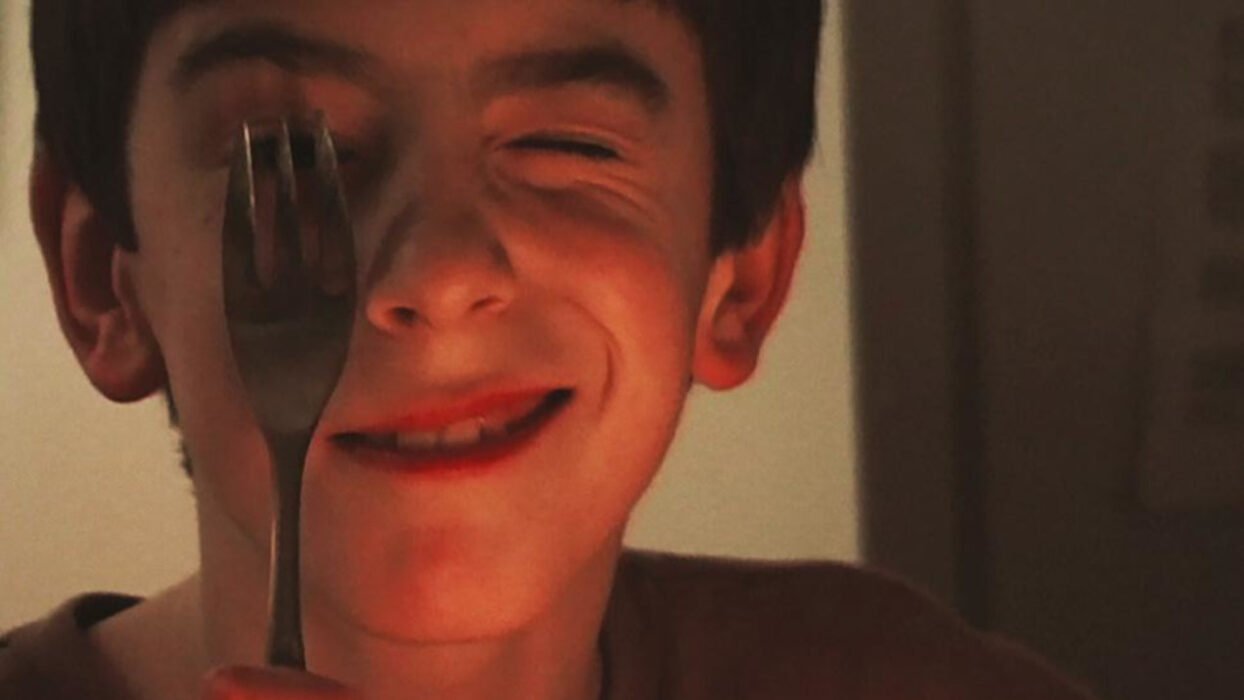
A still featuring a young Adrian McElwee.
As the kind of forefather to the tongue-in-cheek, auto-documentary movement of today, with John Wilson and Nathan Fielder at the helm, Ross McElwee, here, takes a step back to reflect upon a lifetime of constant filming, sometimes with no particular purpose. Assembled with moments from his previous films, as well as his own, personal archive and Adrian’s own recordings, McElwee, takes us through his son’s life, from childhood, to his struggles with substance abuse, and to his passing, as well as his life before Adrian, his own father, and his father’s father.
Ross McElwee, with complete earnest, has made one of the bravest, and most honest documentaries perhaps ever. It’s startlingly real, owning up to flaws and mistakes, baring everything to the screen. Questions on if he was too harsh, if more could have been done, are placed, but not answered. Maybe this film is the answer, at least for McElwee. To me, the audience doesn’t need an answer on these, that’s not the purpose here; the film was not constructed or thought out for an audience, or to illicit tears, or laughter, cheers, awards or criticism, instead, this film was only made with just two people in mind; Ross McElwee, and Adrian. It wasn’t made to celebrate a life either, but to make sense of one. To understand one. And that’s not to say this film doesn’t deserve an audience, or awards or anything else, as it does, truly. It exemplifies that cinema as a medium is in itself a way of understanding, and can be used to tame the absurd, to process reality in a way we choose to, to gain power over it.
McElwee, uses camera, sound and editing to experience life, and admits to it in Sherman’s March, as his good friend Charleen, repeatedly tells him to turn the camera off, and he essentially can’t, it’s like a shield. Remake is no different, but rather than harnessing the camera to become more confident with women, here it’s harnessed against time itself, the past, present, the future, everything.
As the film came to a close, the room remained silent, in fact, the crowd remained silent until it was completely out of the cinema. This is a film that grabs you, it takes you with it, and by the end, you’re left sort of empty, or melancholic. That’s not to say it doesn’t have happier moments, or a few laughs here and there, and in a way that makes it all the more devastating.
Truly, I don’t want to ever see this again. It’s so perfectly upsetting in a way that made me weep. I will tell everyone else in the world to see this, as everyone in the world absolutely should. This film is a masterpiece. It deserves everything Adrian ever yearned for his father’s films to achieve.
