To celebrate the release of YOU CAN SEE EVERYTHING, Katie Quinn of Best Boy Magazine is teaming up with James Hall of Normal Cinema Club for a joint review - perhaps betwixt their two interpretations they find an objective truth.
JH: My relationship with Nathan Fielder began like many others. Funny clips on Youtube. While I can’t pinpoint it for sure, there is a strong chance that the first Nathan For You clip I saw was the same clip that Elizabeth Holmes saw. It is unnerving to think that we might have chuckled at the same moments, glanced through the same unfunny comments, that we maybe even operated on the same lines of code in the algorithm.
KQ: As James previously mentioned, my relationship with Nathan Fielder also began on YouTube, with those same funny moments. However, as it stands now, my relationship and understanding of Fielder goes far deeper than James’ does. I also took the traditional route, funny moments to Nathan For You to that final episode… Finding Frances. I was there for The Curse, for both seasons of The Rehearsal, I went to the Fielder Archives, I have consumed everything Nathan Fielder has ever put out there, and I was ready for You Can See Everything.
JH: I mean, it’s not a competition, but my understanding of Nathan Fielder feels more sensitive and intimate and poignant on account of the masculinity side of it all. When I watched through the series, I was, like everyone else (and presumably Elizabeth Holmes if she ever gets around to it), blown away by Finding Frances. Who would have thunk it? Something funny could also be serious. Fielder’s work since then has pretty much adhered to this formula. What you are watching is funny, but just you wait for the gut punch. The first season of The Rehearsal felt like Fielder reckoning with his past as a ‘comedian’, and facing up to the truths of playing with unwitting members of the public and mocking their reactions. While Nathan for You featured inflections of Fielder’s ‘persona’ leaking through for comic effect, The Rehearsal is structured to buckle under the weight of it.
KQ: “The masculinity side of it all?” Oh yeah, of course only a MAN could understand ART and NATHAN FIELDER whom I clearly have a much better handle on in every possible way… and also I've always considered him a pioneer of funny-but-serious… Anyway, I first heard about this film a few years ago, from a viral tweet that claimed Nathan Fielder had been visiting Elizabeth Holmes in prison. At the time, this was brushed off as something he would be utilising for The Rehearsal season two, but as that came and went, it was left hanging. Had the mystery tweeter been lying? Well, now we know, obviously not. I had a very limited understanding of who Elizabeth Holmes actually was, but was overly excited nonetheless, and once that Telluride screening happened, I couldn’t contain myself any longer. Not just excitement for a new Nathan Fielder project, but for a Nathan Fielder crossover with Lance Oppenheim, and for a Nathan Fielder project I would potentially be able to see in a cinema rather than on my TV.
JH: Reader please forgive Katie, when she watches Nathan For You, she thinks the You means Katie, rather than just a funny title. YOU CAN SEE EVERYTHING is Fielder’s most ‘serious’ work so far, signposted as such in that it’s his least funny. (That said, it is still one of the funniest films of the year.) Fielder is the one invited by Elizabeth Holmes and her husband Billy Evans into their rental home before she is sent to prison. The first question he asks is why they chose him - he’s not a serious journalist, he’s just a funnyman. Is he a pawn in their latest deception/manipulation/game? Does his role mirror Holmes choosing US military personnel for the board of Theranos, potentially hoping they wouldn't notice the patchy science? Not that she would admit that. The film spirals out from this paranoid moment, are Holmes and Evans for real? Or are they using this documentary for their own ends? Are they lying? Does Holmes genuinely believe the words she says?
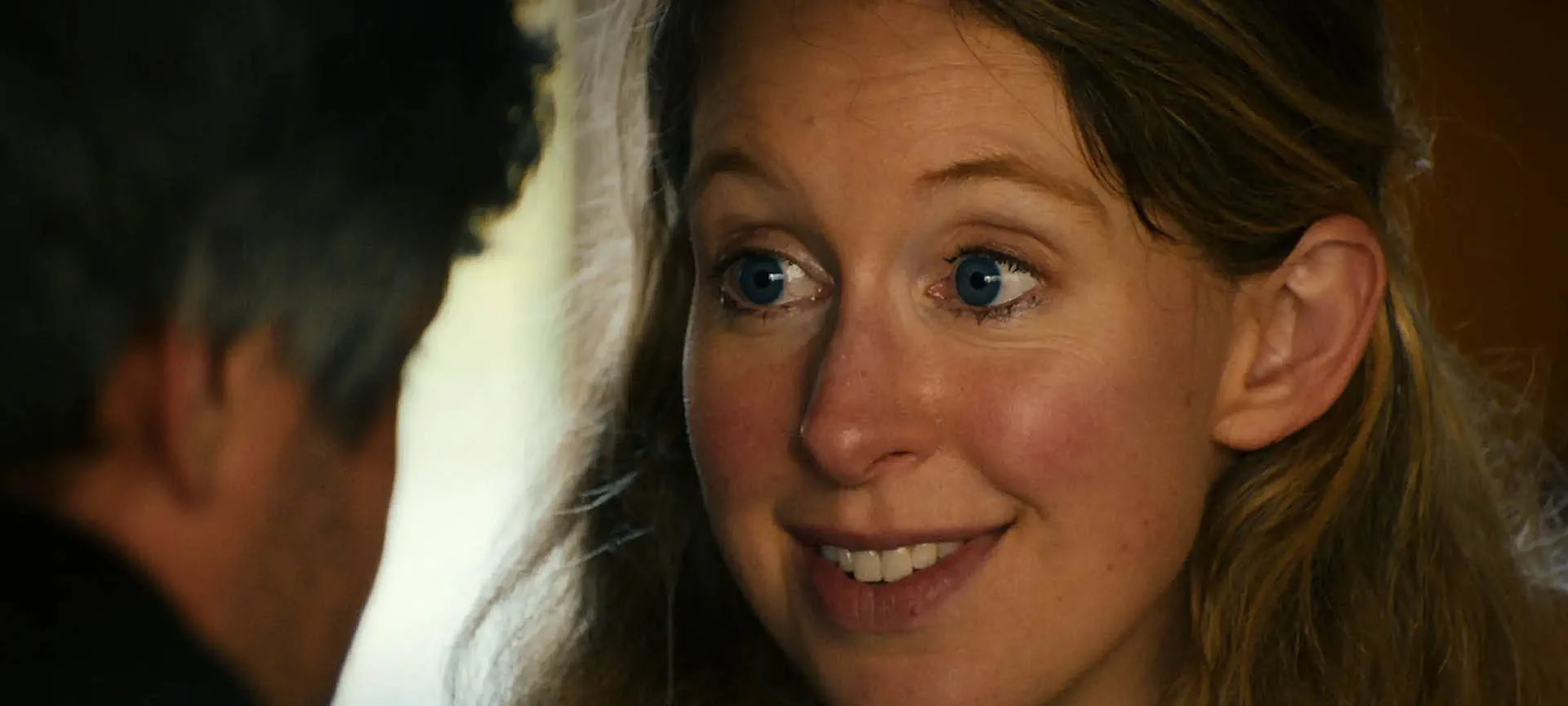
The first chunk of the film is dedicated to this tense stand off between Fielder/Holmes/Evans, through claustrophobic close-ups we watch their eyes examine each other. The cinematography by David Bolen, regular collaborator of co-director Lance Oppenheim, is a true feat of documentary photography, shot on the fly yet incredibly cinematic. Intimate yet distanced, he creates a paranoid world of zooms and reflections where nothing is clear. In some particularly striking nighttime sequences, silhouettes are barely defined beyond a glint of light in the pupils. In a way the visual element further compounds the atmosphere of truth versus fiction, just how on earth did they make it look like this? Surely they're all acting in a 1970s thriller…
KQ: James may be a buffoon, but he’s speaking well here, even with his limited understanding of movies, Nathan Fielder, how a camera works, and so on. Beyond creating a sense of tension and paranoia, the cinematography frames Elizabeth as even more eerily rosy-cheeked and doe-eyed than ever thought possible, like a knock-off Disney princess doll. I can’t help but feel this is the exact look she’s hoping to achieve, but without the creepy part. She looks innocent and uncorrupt, when perhaps she is not so innocent and uncorrupt. She looks “natural”, barefaced, shown up as close as possible, and thus she is being true. She’s not covering anything up, not even her perfectly red nose.
JH: If I wrote that I'd be called a pervert… The beauty of cinema distribution is that a film can be released in America then released everywhere else a month later. The discourse can be had, the spoilers leaked through X (the Everything App) and before you know it, it’s almost not worth watching. We also end up with a particularly skewed bubble of discourse. I avoided reading bonafide reviews for the film, but occasionally glanced at Letterboxd. Just like Elizabeth Holmes watching Nathan For You, I responded in much the same way as most of those wry/sardonic platform users. And yet, watching the film, I was shocked by the alien abhorrent and truly evil presence of Billy Evans. A repugnant, coercive, sickening person, a true villain. In my experience of this pre-spoiler bubble (and reading reviews post-screening), he gets off lightly. What’s all that about? Is this much like the Digger phenomena? Americans (even ones whos opinions I trust and like) didn’t take to the Digger brand of bolshy satire. Does Billy Evans not register as utterly evil to the American movie-going public because everyone is like that now?? I actually don’t know the answer to this :/
KQ: In the month between the American release and me actually seeing it, I managed to avoid spoilers, except for the “Big” one, which was seemingly unavoidable. I personally did not occasionally scroll Letterboxd reviews, as I have decorum and can exercise restraint. Instead, I spent that long month watching The Dropout, to brush up on who Elizabeth Holmes is and what she did; I still was not prepared for what this film actually would be, or how bizarre Elizabeth Holmes really is. I mean, it goes without saying that she is bizarre, we all saw that clip of Amanda Seyfried playing her, dancing to Lil Wayne with green juice and a navy gilet, but the level of uncanny portrayed here is jarring. I still can’t tell if I trust her or not, I can’t tell if she knows she’s lying, I can’t tell if she actually is even lying, or if she has lied so much she believes it herself now. Yet, despite how confusing and odd Elizabeth comes off, I have not been able to stop thinking about Billy Evans, someone I barely knew existed a month ago. He’s haunting my thoughts. Billy Evans is sort of a physical manifestation of modern evil; Charlie Kirk and guns and AI and crypto. Manipulative and misogynistic and stupid. I haven’t been able to stop looking at his twitter, reading the several interviews he’s given since the film’s release, his clear attempts to backtrack and blame the terrible way he comes across on the “manipulative” edit. This opens another can of worms. How manipulative is the edit?
JH: I didn't watch The Dropout because I don't really have the spare time to be doing that, but also because I prefer cinema to television. Regardless, the film’s consideration of works like The Dropout, the Alex Gibney documentary and in turn, its very own existence (and the circumstances in which YCSE was produced) ask thorny questions on the nature of authenticity and truthfulness. Is non-fiction inherently more truthful than fiction? Holmes and Evans aren't happy with either, insisting there's a third option somewhere out there, perhaps even within their own hearts…
KQ: Billy does not come off so terribly because of the edit, he does that all by himself, but he’s highlighting an important point. According to him, there is an insane amount of footage that we aren’t seeing, and I suppose in that, we are being manipulated in one way or another. There could be nothing in this footage, maybe it’s all boring bullshit, but we are being shown very specific things. The edit purposefully reinforces the “limit” of documentary that both Nathan Fielder and Lance Oppenheim have been obsessed with, separately, across their work. People will always perform in front of a camera, and the edit can always change the events, so maybe documentary can’t ever be fully truthful. Where others struggle with this, these two use it to their advantage, putting it at the core of their filmmaking practice. For Lance Oppenheim, it’s the overly stylised, heavily constructed nature of his films, and for Nathan Fielder it’s “rehearsing”, the absurdist cringe comedy and satire, it’s the obsession with human behaviour and understanding it. The second half of the film relies on fragile memory, and the limits of the form are brought to the front again. Can we trust these memories? Has Nathan Fielder’s view of events been corrupted? Perhaps so…
JH: In the film's most poignant moment, and also its funniest moment, Fielder shows Holmes and Evans the famous Abbott and Costello routine “Who’s on First?” He likens it to a conversation they had earlier in the day where he asked if she was lying or innocently miscommunicating about the capabilities of the Theranos machine. Holmes watches it with glazed over eyes, nodding slightly and chuckling respectfully. She doesn't understand, not just the jokes, but Fielder's reasoning for showing it to them. Further probing forces Holmes to break down in tears, and Evans comforts her before sending her to bed. The enigma of Elizabeth Holmes deepens and her completely normal husband who loves her for all the right reasons rushes in to protect her by shielding the truth.
Just like the catalyst of the entire project, a simple YouTube clip is enough to expose the dynamics and mechanisms of a couple working to construct an image, then contort and extort it further. Alex Gibney would never think to throw on a funny clip, but Fielder would. It's funny but also it's serious.
JH&KQ: Mmhmm
YOU CAN SEE EVERYTHING is out on Friday 20th November !
