MAGILLIGAN (ROSS MCCLEAN, 2026)
The prisoner has often drawn the eye of cinema, from fiction films like Bresson’s A Man Escaped, to The Shawshank Redemption or countless exploitative documentaries pumped out by Netflix as part of the true-crime fever that has left many a boring person enraptured.
In Northern Ireland, especially, where Ross McClean’s, Magilligan, takes place, the media pumps out images of vulnerable people: prisoners and addicts at their lowest. Either in prisons or on the streets. The goodies take on the baddies. Specifically, the sort of made-for-ma’s TV documentary hair-dyed mouthpiece Steven Nolan helms, but maybe that’s a separate piece…
Magilligan does something different.
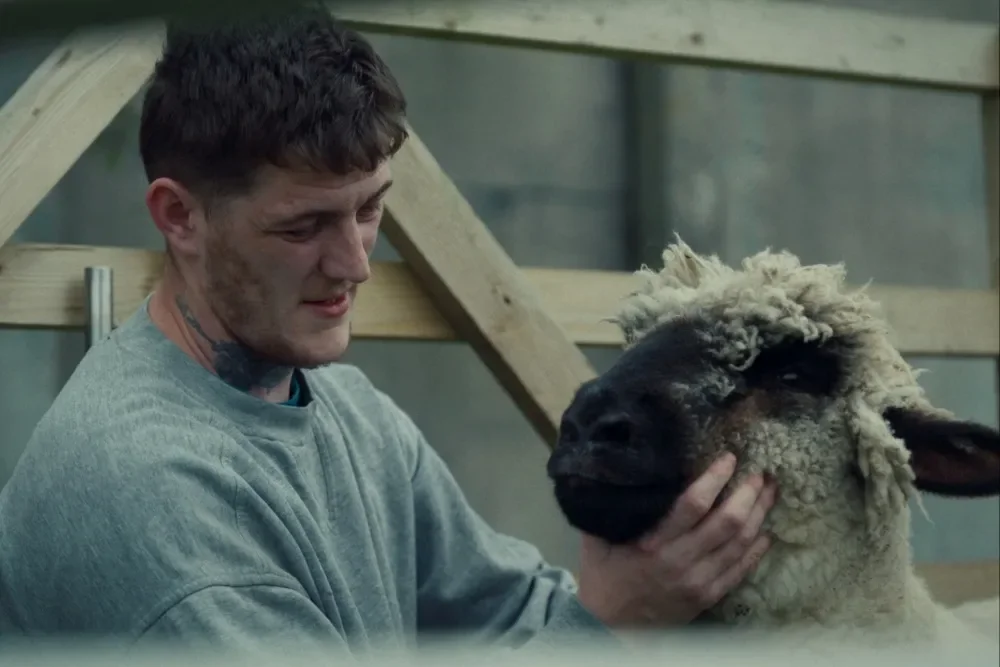
Ryan tending to a sheep in prison.
Ross McClean’s debut feature, Magilligan, can be seen as a sort of follow-up or an evolution from his short, Hydebank. It followed Ryan, a young man at the Hydebank Young Offenders Institute. He finds solace in tending to the institute's resident flock of sheep. The film feels hopeful for Ryan. Magilligan joins Ryan years later. He has reoffended, is in prison and is now using drugs. The film intimately follows Ryan as he navigates the rocky path society lays for someone in his position.
The film is so intimate by the nature of its making. McClean has incredible access to Ryan. We are taken with Ryan to the few places he can go. When he’s in prison, we’re in the cell with him and the other inmates: bantering, lamenting, taking drugs. Then we’re at his mother’s house; we’re in his childhood room as he turns his bed as they do in prison. Or with sheep. Or on the streets of Belfast. We are with Ryan, or perhaps more accurately, we are with Ross. We see glimpses of the filmmaker through the film, an inmate wants to try his camera and turns it on him, or we hear him asking Ryan a question. Or in one scene, Ryan has phoned McClean and asked for a lift as a local paramilitary is monitoring him. There is a true relationship here that you do not often see in films. There is a relationship beyond the filmmaker and the subject.
You see this further in the prison scenes; the filmmaker is in the cells with no minder or large crew. McClean and his producer, Brontë Stahl, sit with the men. I can assume there were hours and hours of footage to work with, as the filmmakers feel truly encamped. The men accept them in their community. Most importantly, there is a palpable trust; Ryan trusts McClean. In many ‘all-access documentaries’ on prisons, we see the prisoners ‘acting’ for the camera to look tough or scary. That’s not to say the men who appear in the prison sections are completely unaware of the camera, but the tripped way is the bravado these documentaries sometimes incur in the subjects. The men are often merely existing. They sometimes seem wholly unaware of the camera. Specifically with Ryan, it is observational in a way audiences will not be used to. A personal relationship built on trust has allowed the subject to act in a vulnerable and natural way.
We are used to fiction films, the heroes and villains. The sheriff puts the bad guy away for a long, long time. Documentaries are meant to be a different world. Or have they ever been? Regardless, increasingly we see documentaries that strip away nuance and observation; they want to tell you about a crime or criminal, presented like a drama or horror film, but tenfold worse because - IT'S ALL TRUE !!! The debates over true crime and its implications are far-reaching and worth a whole different piece. If true crime is the rubbish we are being fed these days, Magilligan, then, is a palette cleanser. It is not interested in a crime and a criminal, but in a person. We aren’t told Ryan’s crime. He talks about it, and we know it’s violent. He regrets it. He is doing his time. At some points, he expresses that he wants to return to society. At some points, he seems to lose all hope. That’s enough to know. There is no manipulative grand statement baked into the making. The film makes no attempt to influence you. It doesn’t need to tell you that Ryan is struggling or that he is making bad decisions; we can see it; we root for him, nevertheless, to be safe and healthy. We can’t help it. No matter how the media tries to dehumanise people.
The film also doesn't have to tell you explicitly that the prison system is failing inmates because we see it. According to the Northern Ireland Statistics and Research Agency, 17% of adults and 24% of youths reoffended within a year. Ryan is an individual, a human being, but he is also one of thousands. In the Q&A after the film, McClean said he hoped the film would spark conversation and plant seeds. It’s hard to watch this and not ask: What is prison for? Is it just a place to hold people for a period of time, like a sin bin? Or is it to help people rehabilitate? Hopefully, this documentary will inspire positive conversations, or at the very least do something to chase away the tide of populist documentaries and fictional TV programmes made about vulnerable people and the justice system.
It’s a staggering and important debut, and we can’t wait to see what McClean does next.
